Anova vs Joule: Sous Vide Buyer's Guide
Cooked with both for months. Anova wins on controls and price; Joule wins on speed and size. Full comparison to pick the right sous vide circulator in 2026.

If you want date-night food that tastes expensive with almost zero stress, sous vide is the cheat code. You season the protein, drop it in a water bath at the exact temperature you want, then sear at the end. No guessing. No “is it done?” hovering. You get to be present, pour a drink, and act like this level of precision is just your personality.
Affiliate note: Some links in this article are affiliate links. If you buy through them, I may earn a small commission at no extra cost to you.
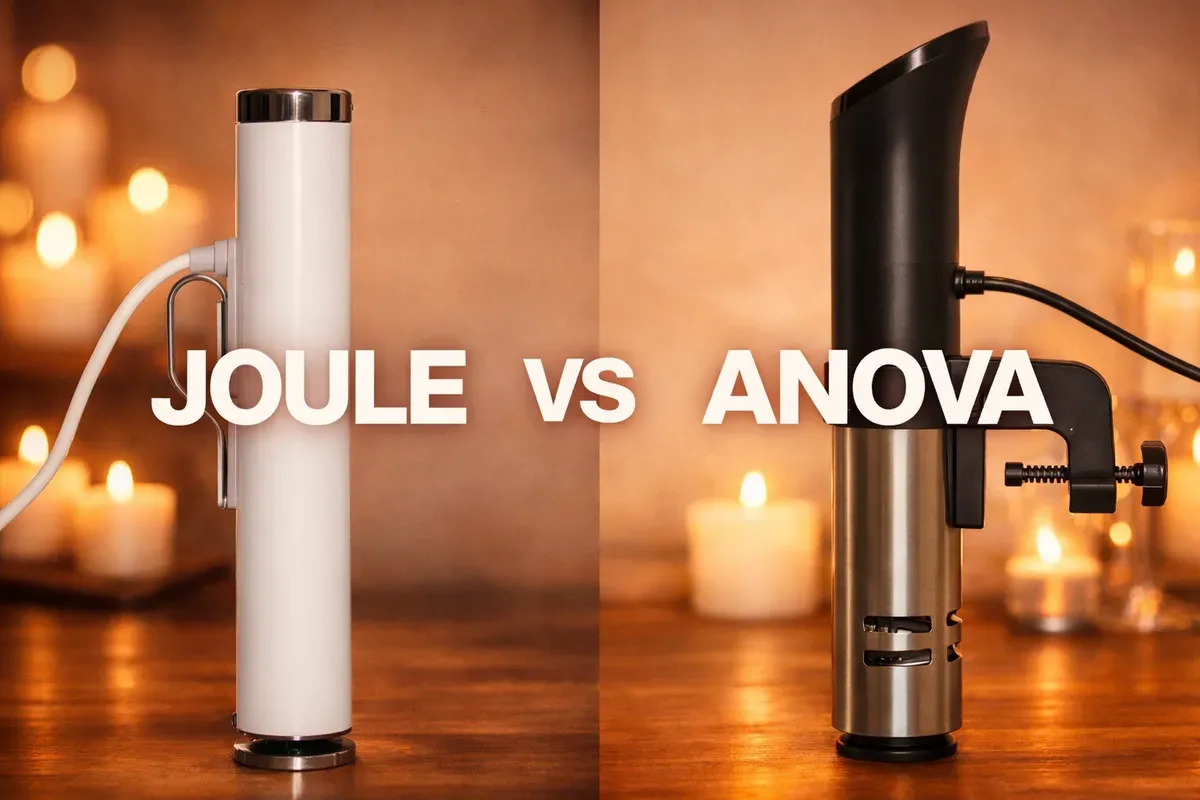
The two circulators everyone actually recommends to first-timers are the Anova Precision Cooker and the Breville Joule Turbo. They both work. They’re both reliable. The difference is in how they work and whether that matches how you cook. That’s what this guide is about.
Quick Start: Anova or Joule?
If you’re in a hurry, here’s the cleanest way to decide. Before we get into it: these two are usually the stronger picks for most people because they offer the best mix of performance, usability, and long-term reliability. Most cheaper sticks can still work, but they tend to be louder, clunkier, and more annoying to live with.
Full transparency: I personally use a Joule Turbo. I like the compact size and the app experience. That said, I’m recommending based on fit, not brand loyalty.
Choose Anova if you want:
- Controls on the device, no app required.
- Something that feels like a normal kitchen tool: set temp, set time, done.
- A huge user base with troubleshooting resources and community recipes.
Choose Joule if you want:
- A compact device that stores easily.
- The best app experience: recipes, guides, timers, notifications.
- A setup that feels modern and phone-first.
Serious Eats’ immersion circulator testing consistently ranks both as top picks for home cooks, with each excelling in its own lane.
What Sous Vide Actually Is
Sous vide means cooking food in a sealed bag in water held at a very precise temperature. The water never goes above your target temp. The food cooks evenly edge-to-edge. And because timing is flexible, you can hold food at temp while you hang out, finish getting ready, or let a bottle of wine breathe.
You still finish most proteins with a fast, high-heat sear. Sous vide handles the doneness. Searing handles the flavor. Two-step cooking that looks like you spent all day on it.
The 6 Things That Actually Matter When Buying
This is what separates “I used it twice” from “this is now my weeknight superpower.”
1. Controls and failure modes. This is less about preference and more about what can go wrong at 8:07 PM when you’re hungry. Anova works even if your Wi-Fi is being dramatic; you set temp and time directly on the unit. Joule’s app is genuinely polished, but you’re opting into a phone workflow. If your phone is dead or the app is glitching, you’re annoyed before you’ve even cooked. If you hate connecting blenders to Bluetooth, go Anova.
2. Wattage and heat-up time. Watts translate to two things: how fast you get to temp, and how well the circulator recovers when you add cold food or use a bigger water bath. A small pot for one or two steaks is easy mode. A bigger container punishes weak circulators. If you think you’ll ever do larger batches, don’t buy the lowest-power option.
3. Temperature accuracy and stability. A good circulator doesn’t just hit 131F. It holds it. Steak is forgiving; a small drift won’t ruin it. Fish is not forgiving; a few degrees can turn “silky” into “flaky and sad.” Eggs are extremely sensitive. Look for reviews that mention holding temp within a tight band over multi-hour tests, not just “it seems accurate.”
4. Pump flow and circulation. Two machines can be equally accurate at the sensor and still cook differently if circulation is weak. In bigger containers, weak circulation creates temperature gradients. Bag placement matters more when circulation is poor. If you’re doing more than two bags at once, you want a machine that keeps water moving well.
5. Clamp design and geometry. This is the most underrated decision point. Look for a clamp that fits both thin pot walls and thicker plastic containers, one that doesn’t slip when condensation builds. If the clamp is annoying, you’ll avoid using the machine. That’s the real science.
6. Water level and evaporation management. Sous vide is quiet, slow cooking, and water disappears. Every circulator has a minimum water line; dip below it and it will alarm or shut off. Evaporation accelerates with hotter cooks and longer times. First-timer rule: for anything longer than two hours, cover the bath. For anything longer than six hours, cover it for real with a lid, wrap, or a proper container lid.
Head-to-Head: Anova vs Joule
Anova Precision Cooker
Best for first-time buyers who want “set it and forget it” without relying on an app.
On-device controls make this the most approachable entry point. Straightforward learning curve, easy to recommend, and backed by the largest user community of any home circulator. The trade-off is size: it’s bulkier than the Joule, and app features vary by model and generation.
Joule Turbo
Best for people who like app-guided cooking and want the smallest, sleekest setup.
Very compact and easy to store. The app experience is the best in the category: visual doneness guides, timers, push notifications when your cook is done, and a recipe library that actually makes sense. Heating speed is fast. The trade-off: it’s app-first. If you’re not a phone-in-the-kitchen person, you’ll find the workflow friction annoying. The magnetic mounting style is also not everyone’s favorite.
What Else You Need: First-Time Buyer Checklist
Sous vide isn’t just the stick. The stick is the brain. Here’s the rest of the setup.
A container. Start with a pot you already own and upgrade later. If you want a dedicated setup that holds temp more efficiently and makes managing the waterline easier:
Bags. You do not need a vacuum sealer on day one. Regular freezer zip bags plus the water displacement method work just fine. Seal the bag almost completely, lower it slowly into the water bath so pressure pushes air out, then finish sealing.
A way to sear. Sous vide gives you perfect internal doneness. Searing gives you the crust, the color, and the Maillard reaction that makes it taste like restaurant food. Use a cast iron skillet over high heat and dry the protein aggressively with paper towels first.
The 4 Beginner Mistakes That Ruin First Cooks
1. Not drying before searing. Pat the protein aggressively dry with paper towels right before it hits the pan. Wet meat steams instead of sears, and steaming after a long, careful cook is a tragedy.
2. Over-seasoning. Flavors concentrate in a sealed bag during cooking. Season a little lighter than you normally would going in, then taste and adjust after the sear.
3. Floating bags. A floating bag means the protein isn’t fully submerged, which means uneven cooking. Fix it: use the water displacement method properly, clip the bag to the side of the container, or add a spoon outside the seal as a weight.
4. Starting with the wrong first cook. Your first win should be forgiving. Good starting points: chicken breast (juicy at 140 to 145F), salmon (silky at 120 to 125F), steak (129 to 134F for medium-rare). These proteins showcase what sous vide does best before you graduate to eggs or fish.
Why Sous Vide Is Actually Romantic
Sous vide buys you time. You can start the steak hours before your date arrives, then sear in 90 seconds when you’re ready to eat. No panic. No overcooked meat. Just confidence.
And yes, this is the part where you can fully disappear for a while. If you end up making out on the couch while the Joule quietly holds the bath at the exact temp, dinner will still be fine when you come back. That’s the whole romance of it.
For a full date-night game plan built around sous vide, including timing, what to prep ahead, and how to plate without stress, the sous vide date-night guide has everything you need.
Recommended Products
Anova Precision Cooker (sous vide immersion circulator)
Best first-time buyer pick with on-device controls
Breville Joule Turbo sous vide immersion circulator
Most compact, app-first circulator with fast heating
Sous vide container with lid, 12-16 quart
Dedicated container for hands-off, stable cooking
Freezer zip bags (gallon, freezer grade)
Beginner-friendly alternative to a vacuum sealer
12-inch cast iron skillet
The classic finish for perfect sous vide proteins
Victor Vu
Victor is a Montreal home cook with a decade of experience developing date night recipes. Every dish is tested at least three times before publishing.
About the author →Frequently Asked Questions
Is Anova or Joule better for beginners?
Anova is better for most beginners because it has on-device controls and does not require a smartphone app to function. You set the temperature and time directly on the unit, cook, and sear. Joule suits people who prefer app-guided cooking and want the most compact device on the market.
Do I need a vacuum sealer for sous vide cooking?
No. Beginners can use regular freezer zip bags with the water displacement method: seal the bag almost completely, lower it into the water slowly so pressure pushes out the air, then seal the rest. A vacuum sealer is a nice upgrade later but is not required to get great results from day one.
What should I cook first with a sous vide circulator?
Start with chicken breast at 140 to 145F, salmon at 120 to 125F, or steak at 129 to 134F for medium-rare. These forgiving proteins showcase what sous vide does best: edge-to-edge even doneness with no guesswork. Finish every cook with a fast, high-heat sear for color and crust.